Tuesday, January 15, 2019

Local Diners and Overalls

In the heart of most every southern town is an almost daily "meeting of the minds".   

This morning as I sat eating breakfast in the company of good friends and strangers, I began to look around and take note.  Through the clatter of dishes, the laughter,  and  the old men arguing I began to see another tradition that seems to be fading away.    Almost daily, men and women gather around tables, booths, and counters all over the land to discuss the weather,  politics,  religion,  high school sports,  and  anything else that makes good gossip.   I  love it!  Often the faces of those who gather are wrinkled and worn, but sometimes they are pierced and tattooed.   Either way,  I guess they gather because they have learned the secret to  the local diner.   It is here that lies are told,  legends are made, and lives are filled. 


If you seldom take part in your local "meeting of the minds", maybe you should.  The topics may not be relevant,  the stories may not be be new, but one thing is for sure, the heartbeats of the ones there are much stronger when a new face takes interest in what they have to say.

Seek out your local diner. Spend a little time there in conversation with the old man in overalls,  with the kid wearing baggy pants,  with the guy in the cowboy hat, and don't forget to talk with the ones serving all this madness.  Whether you fit in with the late night after-ballgame crowd,  the early morning coffee sippers, or the lunchtime gathering,  it is at the local diner that you will find a wisdom deeper than the words that you will hear.  


I'm afraid  one of the biggest mistakes we make is assuming that others think the same way we think. Young or old,  we were made for interacting with each other.   It seems the less we get to know our neighbors,  the less we know ourselves.   


Just my ramblings for the day,  JEJ


Going out today!


Non nobis Domine


Monday, January 14, 2019

Today's carry

Just thought I would share today's carry.   Someone is going to get a leatherman micra today. 

Non nobis Domine

Saturday, January 12, 2019

The best view comes after the hardest climb


"The best view comes after the hardest climb"


This old photo from 10 years ago was taken shortly after a difficult climb both physically and mentally. Many times in life it's easy to give in, to back off, or simply walk away. I have always believed that overcoming obstacles and adversity are what makes the journey more memorable. 

Now this spot was not that high in altitude. It didn't overlook some grand valley, nor some beautiful lake. I have driven in an automobile to scenic overlooks where the view was beautiful, but few are etched into my mind like the ones that appear after hours of difficulty on the trail. Ahh, those are the sweet ones. The ones that the memory clings to. 

Our lives are filled with trials and tribulations, and it is in those moments of determination where we have to dig deep, that is where we find the "best views". 

Persevere in your struggle. The view will be worth it.

Friday, January 4, 2019

The Kind Of Men Who Carry A Pocket Knife

The Kind Of Men Who Carry A Pocket Knife


Less than 40 years have passed and I am astonished to see how the times have changed since my father bought this knife for me as just a small boy. I do still have it, which by today’s standards is an anomaly. I’ll leave the discussion of our throwaway culture for another time.


Yes, this pocket knife has witnessed many changes in our society. Technology, communication, transportation, and even education have dramatically changed from the way it was just a generation ago. My pocket knife and I are neither quite certain if all the changes have been for the good. When I look across the landscape of America and take note of the differences, the greatest change that I see is in the people themselves.


Growing up in rural Northeast Alabama in the foothills of the Appalachians, I was privileged to catch the tale end of what was an era marked by ruggedness and self-sufficiency. I grew up around men that were willing to fix what was broken and take the time to do it right. My father was a Vietnam veteran and the product of growing up farming the hills of these same mountains where I was raised. He always carried a small pocket knife much like the one pictured. He had an affinity for Case knives, but would carry the occasional “Old timer” or “Buck” or even “Schrade”. One thing was for sure, that he had one with him, wherever he was.  You could also be pretty sure that his pocket knife would be so sharp that if you were to stare at it too long your eyeballs would bleed.   Now that's pretty sharp....    The pocket knife was an important part of his life. Whether it was to slice a freshly picked apple, or to cut some twine, (coincidentally twine can patch most any broken farm implement until you can get home) he was always prepared. At Christmas time, my father always had his knife waiting to help open those pesky gifts that needed cutting open as only a father can do best.


My father was not the only man in my young life that I watched wield his trusty 3 bladed pocket knife as if it was a surgeon's scalpel. My uncles, my friend’s dads, my bosses, they all carried pocket knives. I watched. I learned. I saw a resourcefulness in the these men, that is seldom seen today. For my father and so many others of a generation gone by, a pocket knife was an essential tool for daily life. The men who carry pocket knives are hardworking, do it yourselfer types, who were raised to rely on themselves and be prepared in nearly every situation. I have seen a pocket knife start a tractor, remove a splinter, slice a watermelon, carve a toy, and open a can. They have been used to clean wild game, cut gum/tar out of hair, sharpen a pencil, cutting fishing bait, and teaching responsibility. The list goes on and on. The uses of the pocket knife are as varied and strong as the men who use them.


I adopted this tool at a very early age as one that would always be at my side. A pocket knife has always been a part of who I am. So much so that I was almost offended when I would encounter a grown man who didn’t have one in his own pocket. I took it upon myself in my 20’s to start gifting knives. Sometimes to random strangers, sometimes to close friends. The conversation would generally start by asking if I could borrow someone’s knife, knowing full well that I had 2 in my own pocket. If the answer was a proud “why sure”, then I would gladly take the knife and inspect it for its level of wear as an indicator of how much work it had actually seen. Often paying a simple compliment as I return the knife. If the answer was that they didn’t have a knife to let me borrow, I would quickly reach into my pocket and deliver one to their hand along with a reference to the fact that every man should carry a knife. To date, I have given out somewhere north of 300 knives.


So, who are the kind of men who carry pocket knives today? They are typically utilitarian. They are the type of men who work hard for a living, fix what is broken, and stand fearless in the face of a world full of evil. To put it simply, they are the type of men that I feel this world needs more of.


If you find yourself in a tight spot and need some help, just ask the guy with the pocket knife. Although they are few are far between these days, chances are he can and will be able to lend a hand.


I carry, do you? JEJ


Until next time:  Be Safe. Be Careful. Behave. Don’t Do Anything Illegal, Immoral, Unethical, Or Just Plain Stupid.  

Wednesday, November 22, 2017

Wild Turkey in Alabama

"WILDLIFE WEDNESDAY" 


When I say "Wild Turkey in Alabama" I'm not talking about the bourbon of choice this Saturday in at the Iron bowl. 
I am talking about meleagris gallapovo. 

A game bird native to North and Central America.  


The wild turkey is the most popular game bird in the world.  Without a doubt the wild turkey is one of wildlife conservation's best success stories.  In the early 19th century the population of wild turkey had been reduced to about 30,000 birds.  Through much effort on the part of private and government agencies working together the wild turkey has rebounded to approximately 7 million birds in North America. 


There are 5 sub species of turkey in North America.  

http://www.outdooralabama.com/subspecies-north-american-wild-turkey


Photos courtesy of the National Wild Turkey Federation

EasternNWTF.jpg

The Eastern wild turkey (Meleagris gallapavo silvestris) is one of the largest of the five subspecies. Adult males, or gobblers, may weigh 20 pounds or more. The body feathers of gobblers have a rich, metallic, copper/bronze iridescence. The tips of the tail feathers have a dark buff or chocolate brown color. Hens have a drab appearance to help camouflage them while setting on the nest. The Eastern wild turkey inhabits most of the eastern forest, from southern Canada to north Florida and westward to Texas, Iowa, and Minnesota. The Eastern subspecies of the wild turkey is the one that inhabits Alabama.

OsceolaNWTF.jpg

The Florida wild turkey (Meleagris gallapavo osceola), also called the Osceola, is found only on the peninsula of Florida. This subspecies of wild turkey was named for the Seminole Indian Chief Osceola. It is similar to the Eastern wild turkey, but smaller and darker in color, with wider black bars on the wing feathers. The large tail feathers are tipped with brown and are similar to the Eastern. These turkeys inhabit the piney woods, prairies and hardwood hammocks of south and central Florida. 


RioGrandeNWTF.jpg

The Rio Grande wild turkey (Meleagris gallopavo intermedia) is native to the brushy scrub of the southern Great Plains, western Texas, and northeastern Mexico. They may be found in elevations up to 6,000 feet in mountainous areas, but generally favor country that is more open than the woodland habitat favored by their Eastern cousins. Overall, Rio Grande turkeys are comparatively pale and copper colored. They are distinguished from the Eastern and Florida subspecies by having tail and rump feathers tipped with yellowish buff or tan color. Rio Grande turkeys may form large flocks of several hundred birds during the winter months and may range several miles from roosting sites each day. 

MerriamsNWTF.jpg

The Merriam’s wild turkey (Meleagris gallopavo merriami) is found primarily in the ponderosa pine, western mountain regions of the United States. Adult males are distinguished from the Eastern, Florida, and Rio Grande by the nearly white feathers on the lower back and tail feather margins. It is comparable in size to the Eastern turkey, but has a blacker appearance with blue purple and bronze reflections.
Archeologists believe that about 2,000 years ago the Native Americans of the southwestern United States domesticated a turkey similar to the wild Merriam’s turkey. When the Spanish explored southern Mexico in the middle 1500s, they found tame turkeys being kept by Native Americans throughout that area. This now extinct turkey of southern Mexico (Meleagris gallopavo gallopavo) is believed to be the ancestral stock of the domestic turkey that the Spanish encountered. This domesticated turkey was brought back to Spain and was widely accepted throughout Europe. The domesticated turkey was brought back to America by the English colonists of the Atlantic seaboard.
 

GouldsNWTF.jpg

The Gould’s turkey (Meleagris gallopavo mexicana) is found in portions of Arizona and New Mexico, as well as northern Mexico. The Gould’s turkey is a bird of the mountainous areas of this region. It is the largest of the five subspecies and resembles the Merriam’s turkey. They have longer legs, larger feet, and larger center tail feathers than any of the other wild turkey subspecies in North America. Gould’s differ by having distinctive white tips on the tail feathers and tail rump coverts that usually separate to show an “eyelash” appearance. Lower back and rump feathers have copper and greenish-gold reflections, unlike the faintly iridescent velvety black found on the Merriam’s. Gould’s body plumage is somewhat blue-green in coloration.

OcellatedNWTF.jpg

The Ocellated turkey (Meleagris ocellata) is a different species than the other wild turkeys of North America. The Ocellated turkey only exists in a 50,000 square mile area of the Yucatan Peninsula in Mexico, Guatemala, and Belize. The Ocellated turkey is easily distinguished from its North American cousins in appearance. The body feathers of both male and female birds have a bronze-green iridescence. The tail feathers in both sexes are blue-gray in color, with a well-defined eye-shaped, blue-bronze colored spot near the end, followed with a bright gold tip.


The Aztec of Mexico domesticated the Mexican subspecies of the wild turkey (called guajolotes) and the Spanish explorers took some of these back to Europe in the mid-16th Century where they became common farmyard animals. These domestic turkeys eventually completed the circuit and came back to North American turkey farms from Europe. In fact the domesticated versions are so much larger and with so much more breast meat that they are unable to fly and have lost the instincts their wild cousins depend upon for their survival. The Mexican subspecies is now endangered in the wild but the other subspecies in North America are thriving.


Wild turkeys can fly and run at incredible speeds. They reach up to 55 mph flying and 25 mph running. They are also far more beautiful than the white domestic version that becomes the supermarket’s butterball. The wild turkey’s dark feathers are iridescent with shades of red, green and copper that shine when hit by the sun. The male bird (called a gobbler, or Tom) is the most colorful with a bright red head and neck wattle with a beautiful fan of tail feathers that it spreads out to impress the lady turkeys (called hens).


So if you sit down to a thanksgiving turkey meal this year, you should think a little about the wild turkey and give thanks and respect to the history of where the bird came from.  

UNTIL NEXT WEEK  

BE SAFE, BE CAREFUL, BEHAVE, DON'T DO ANYTHING ILLEGAL, IMMORAL, UNETHICAL, OR JUST PLAIN STUPID


Wednesday, November 15, 2017

Fungus Among Us!


"WILDLIFE WEDNESDAY" 


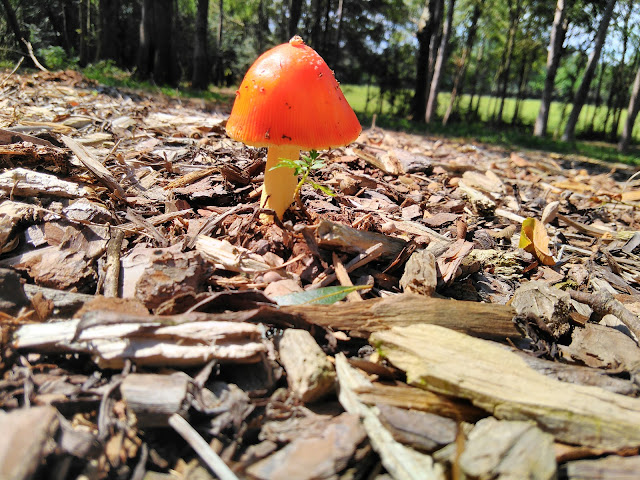
These photos are left unidentified on purpose.  It is easy to mislabel mushrooms and with the fairly common occurrence of poisonous fungi, I will leave the i.d. to true experts (I think you would do well to do the same).  


Mushrooms can be aesthetically pleasing parts of the natural landscape and can also serve as a source of edible goodness for those that have the taste for them and are able to safely identify the ones that will not kill you.   

Image result for red mushrooms of alabama


In general, this is my response to the often asked question "Eat or don't eat this mushroom":   

Possible but...... Can't tell from the photo, so NO.

 Simple rule, don't eat what you are not sure of . In general these are the rules I follow:


Avoid mushrooms with white gills, a skirt or ring on the stem and a bulbous or sack like base called a volva. You may be missing out on some good edible ones, but it means you will be avoiding some deadly ones

Avoid mushrooms with red on the cap or stem. Again you will be missing out on some good mushrooms but more importantly you won't be picking poisonous ones.

Finally don't consume any mushrooms you are 100% sure of what they are. I know I have already mentioned this but it is by far the most important rule.
Avoid mushrooms with red on the cap or stem. Again you will be missing out on some good mushrooms but more importantly you won't be picking poisonous ones.
Finally don't consume any mushrooms you are 100% sure of what they are. I know I have already mentioned this but it is by far the most important rule.


Image result for red mushrooms of alabama


Wednesday, November 1, 2017

Fairy rings: The Folklore and the Science


"WILDLIFE WEDNESDAY"


The Folklore and the Science of Fairy Rings
Recurring Fairy Ring Snead, Al


Common Name:     Fairy ring, Elf ring, Fairy circle, Elf circle, Pixie ring, etc.

Scientific Name :    Hocus pocus nonsenseicus  


The magical fairy ring, where elves, fairies, pixies, and the like come to dance and play.  Through much of European history fairy rings have been a part of much folklore.  Once viewed as an off-limits area for us mere humans,  the reality behind these rings is a little less mystical than tales of dragons and tiny magical beings, but the science behind this interesting phnomenon is still pretty cool.  


 A  little science behind fairy rings


What causes them?


These imaginative circles are the result of a particular pattern of mycelium growth. Mycelium is the underground organism that produces the reproductive fruit bodies that we know as mushrooms. This relationship is sometimes explained by comparison to an apple tree. If we think of mushrooms as apples, then the mycelium is the tree from which they fruit.In this analogy the tree is underground, but you get the idea. ;)In the case of a ring, the mycelium starts as a single point and grows in a circular shape. It continues to push outwards in an attempt to consume more nutrients. As it exhausts the nutrients on the inside of the circle, it will widen further and further as it looks for a new food source.This process results in an ever-growing circle, that doesn't start to grow back inwards or cross over on itself because there's no new food on the inside of the circle. The mycelium may have started at one point, but soon it has nowhere to go but in an outwardly, circular direction.


Although not uncommon, fairy rings don't just happen anywhere. Multiple factors influence this circular growth pattern, including soil type and condition, amount of nutrients in the soil, obstructions underground, and dirt composition. The ground needs to be even and well composed, a reason why you'll often see them pop up on lawns.

The chance exists that you've seen more fairy rings than you realize. Although we only notice them when they produce mushrooms, the circular mycelium underground is always there and growing. 


There are about 60 different species of mushrooms that produce fairy rings; Marasmius oreades, Agricus campestris, Lycoperdon spp., and Scleroderms spp. being the most common.


 Now that I have sucked the fun out of Fairy rings by being all sciency and stuff here are some fun facts:
  • The rings will continue to grow over time, resulting in a pattern that can be thousands of feet wide, and hundreds of years old.
  • One of the most impressive rings ever was found in France, and suspected to be about 2,000 feet (600 meters) wide and over 700 years old!
  • Time, environmental factors, and animal droppings may replenish the nutrients in the center of the ring once it is wide enough. This can result in a second ring growing inside the first.
  • Depending on the soil and the weather, a ring may expand radially from 3 to 19 inches per year.
  • There are many other fun names for this phenomenon, including elf ring, pixie ring, and fairy circle.


Fairy Rings are still a part of folklore today and I feel that even though we understand the science behind them, they are sure to inspire the thoughts and imagination of generations to come.


Wednesday, October 25, 2017

Alabama Fox Squirrel

"WILDLIFE WEDNESDAY" 


Alabama Fox Squirrel


Scientific:  Sciurus niger

Common:  Fox Squirrel, eastern fox squirrel, Byrant's squirrel


This squirrel is the largest species tree squirrels native to North America.  They are found primarily on the eastern United States.  Their range extends into Canada but they are not considered native to the New England States and are seldom seen there.  They prefer an open forest without a dense under-story.  

The Fox Squirrel's body length is typically from 15" to 27" in length with a tail in excess  of 12".  Adult males can often reach 3lbs.  The color is probably the most varied of all squirrels.  They are distinguished by black, red, grey, and silver hair and often they will have a reddish tail.  One characteristic, that is fairly consistent, is the black face mask with the tips of the nose and ears being white. 

The fox squirrel is an opportunistic feeder but primarily feeds on nuts, acorns, seeds, fruits, buds, insects, and fungi.  Most of their water needs are obtained from succulent vegetation or licking dew from leaves.  (The one in the photo is clutching some form of food tightly in his right paw)


Wednesday, October 18, 2017

Little river canyon: "Pass it on down"

"WILDLIFE WEDNESDAY" 


"Pass it on Down"


The country music group "Alabama" ,one of the best selling music groups of all time, wrote the song Pass it on down to tell a story about a near magical place in Northeast Alabama called Little River Canyon.  


Little River Canyon is recognized as the deepest canyon east of the Mississippi river.  The Little River Canyon National Preserve is truly a natural wonder.   This Saturday October 21st they will be celebrating the 25th anniversary of the preserve.  


Little River Canyon National Preserve – Alabama’s most visited National Park

This article linked above tells a good history of how "the canyon" became a national preserve.  I vividly remember talking with a friend back in the early 90's who grew up in the area. He and his family were not in favor of the national preserve.  This article details some of that sentiment and  
highlights much of the improvements that have come from the development of the national preserve.  


 If you live in Alabama and have never been to the Canyon, 1st off shame on you, 2nd you should make a priority to catch the impressive views in the preserve this fall as the leaves change colors.  The 25th anniversary celebration will be a great time to visit and learn about the history and natural wonders of this place.   


UNTIL NEXT WEEK  

BE SAFE, BE CAREFUL, BEHAVE, DON'T DO ANYTHING ILLEGAL, IMMORAL, UNETHICAL, OR JUST PLAIN STUPID


Wednesday, October 11, 2017

Biological Succession

"WILDLIFE WEDNESDAY" 


"THE RED FIELD"


"Biological Succession"


This photo is a picture of what our family has always affectionately referred to as the"Red field".  This land has been in the same family for many many generations.  The soil has a very red color much different than that of the surrounding soil types of the area.  Now I realize that it doesn't look much like a "field" in this photo.  In my memory it was once a vast corn field as large as anything you would see in the midwest.  


As a young boy I vividly remember getting to take a turn guiding that old Ferguson tractor as it pulled a single bottom plow through that red dirt (I'm sure my brothers had fond memories of the same). Those corn rows stretched on for what seemed forever.


You may be wondering why I have posted a picture of a forest and am talking about it being a corn field. The word Agriculture comes from the latin Ager, meaning "field" and cultūra, meaning "cultivation or growing". Somewhere along the lines, our family decided to stop using the land for agriculture purposes and then a natural cycle took control . No more humans "tending the land" left it up to nature to take care of it. Biological sucession is the resulting process. It is the process where one wave of growth takes the place of another.


This plot of land is now a typical northeastern Alabama mixed deciduous forest. It is the product of many things that happened to it in the past. Soil, climate, geology, lumbering and farming have made it what it is today.
Natural forces continue to work to produce change. As the new
vegetation covers the scars made by man, one wave of growth sets the stage for another. Slowly the forest matures, and one kind of plant or animal replaces another in a natural cycle called succession. As succession runs its course, some elements of the present environment may not be here someday because
they won’t “fit” this place anymore. The elements of succession are very evident in the differing ecosystems that exist in the Southern landscape we call home. The study of succession remains at the core of all ecological studies.


Each of the those waves have a term that science guru's use to describe them. Pioneer (early), Intermediate, Climax, Primary, Secondary, Cyclic, Regeneration, Trophic Cascade etc. They are all just terms to describe change. The only thing that I can guarantee about this world is that everything changes. Everything is linked together. If one part changes, for whatever reason, everything else tends to have a change as well. The beauty of this system is that the earth has a tendency to follow certain rhythms and orders. That's what the study of succession is all about. It is a bit hard to appreciate the changes since they often take place over the course of many many years. Change is always happening in all forms of life. We seldom stop our busy world long enough to notice it.


A good friend tagged me in a Nat Geo Video earlier this week and I think it fits this "WW" article very well. It is about how succession can be effected by wolves. The wolves of yellow stone changed the way biological succession was going. When they were reintroduced back into the ecosystem things started changing back to a more natural state. I will post a link to this video below.


Aldo Leopold once said that "the oldest task of the human race was to live on a piece of land without spoiling it". Succession happens because of changes, natural and unnatural. The key is trying to understand how our plans are effecting the cycle.


https://www.youtube.com/watch?v=ysa5OBhXz-Q


UNTIL NEXT WEEK  
BE SAFE, BE CAREFUL, BEHAVE, DON'T DO ANYTHING ILLEGAL, IMMORAL, UNETHICAL, OR JUST PLAIN STUPID

Wednesday, October 4, 2017

Conoclinium coelestinum: Blue Mistflower, Wild Ageratum, Mistflower

"WILDLIFE WEDNESDAY" 


"Blue Mistflower"


Scientific: Conoclinium coelestinum


Common: Blue Mistflower, Wild Ageratum, Mistflower


Blue Mistflower is native to the eastern part of the United States, from zones 5 – 9. Blount County Al was where this specimen was observed. Blount county and much of Northeast Al is in zone 7b (I may do a "Wildlife Wednesday" on hardiness zones. Often plants and animals stick to certain temperature/climatic zones). Mistflower is often found on sandy forest edges and creek banks. That makes Sand Mountain a perfect place for it to call home. It will grow to about 3 feet tall. It has triangular shaped leaves that are positioned opposite each other. The plant forms clusters of bright blue, violet, or white cone shaped flower heads that are about 1/4" long. The flowers appear from June - November. Once established, it spreads by underground rhizomes to quickly colonize large areas, leading some to consider it an invasive pest plant. A cold winter will kill it to the ground, but it comes back in the spring. Butterflies and bees are known to love this plant, visiting it in droves. It’s a nice addition to a native butterfly garden as a nectar plant.
 There is some very good information on this and other wildflowers and plants in Alabama here:  http://floraofalabama.org/Plant.aspx?id=652

Although the map shows this plant to not be present in Blount county, but these photos beg to differ.  I am located very close to the Marshall county line where they are supposed to be present so I guess that is good enough for me.....


UNTIL NEXT WEEK  
BE SAFE, BE CAREFUL, BEHAVE, DON'T DO ANYTHING ILLEGAL, IMMORAL, UNETHICAL, OR JUST PLAIN STUPID

Oh the knives that have been lost through the years...

Since the post about " The kind of men who carry a pocket knife ", I have had a good bit of discussion about the pocket knife in t...